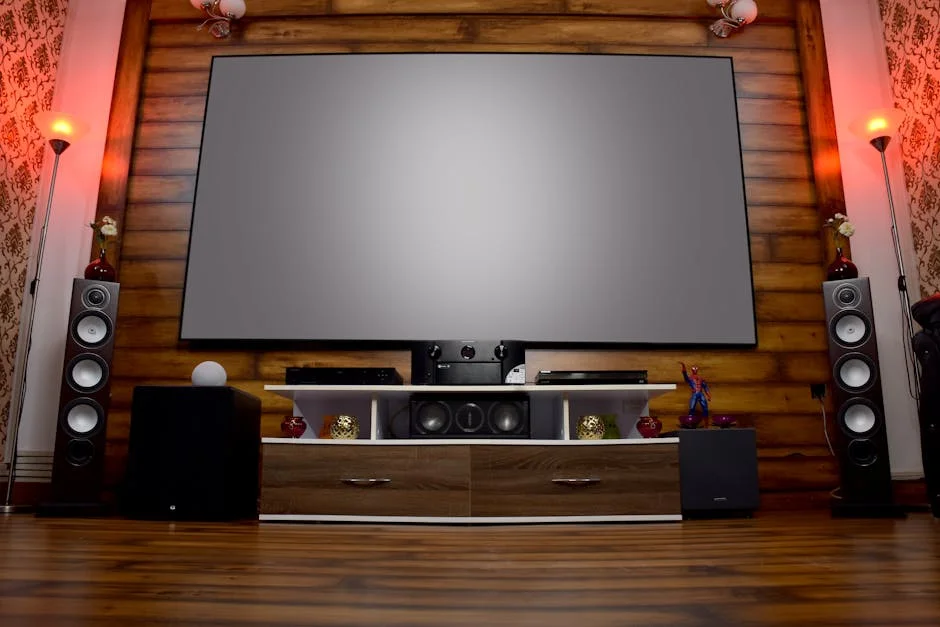
AV Receiver vs Soundbar: Which Should You Choose

Affiliate disclosure: Some links on this page are affiliate links. If you buy through them we earn a small commission at no extra cost to you. Recommendations are research-driven; we don't claim personal use of every product reviewed. Product prices and availability are accurate as of the date published and are subject to change. Always check Amazon for current pricing before purchasing. Learn more.

Quick Picks
Pyle 100W 5 Channel Audio Amplifier - Wireless Bluetooth Home Theater Power Stereo Receiver with Surround Sound w/HDMI, AUX, FM Antenna, Subwoofer Speaker Input, 12V Adapter - PFA540BT.6
Buy on AmazonDenon AVR-X1700H 7.2 Channel AV Receiver - 80W/Channel, Advanced 8K HDMI Video w/eARC, Dolby Atmos, DTS:X, Built-in HEOS, Amazon Alexa Voice Control
Buy on Amazon| Product | Price Range | Top Strength | Key Weakness | Buy |
|---|---|---|---|---|
| Pyle 100W 5 Channel Audio Amplifier - Wireless Bluetooth Home Theater Power Stereo Receiver with Surround Sound w/HDMI, AUX, FM Antenna, Subwoofer Speaker Input, 12V Adapter - PFA540BT.6 also consider | $ | Buy on Amazon | ||
| Denon AVR-X1700H 7.2 Channel AV Receiver - 80W/Channel, Advanced 8K HDMI Video w/eARC, Dolby Atmos, DTS:X, Built-in HEOS, Amazon Alexa Voice Control also consider | $ | Buy on Amazon | ||
| YAMAHA RX-V385 5.1-Channel 4K Ultra HD AV Receiver with Bluetooth also consider | $ | Buy on Amazon |
I spent years defending a soundbar to myself. It was tidy, the remote worked, and the kids never complained. Then I actually sat down and compared what I was hearing against what the source material was capable of delivering, and the math stopped working. That experience is the lens I bring to the AV receiver vs soundbar question, and it is a question worth answering carefully rather than reflexively.
The choice is not simply about audio quality in isolation. It is about what kind of system you are willing to build, maintain, and live with. Before going further, the Home Cinema Basics hub covers the foundational concepts that underpin everything discussed below, including speaker placement, room acoustics, and source device selection.
What It Is: AV Receivers and Soundbars Defined
The AV Receiver
An AV receiver (AVR) is the central processing and amplification hub of a dedicated home theater system. It accepts audio and video signals from source devices, applies digital signal processing (decoding formats like Dolby Atmos or DTS:X), amplifies the processed audio, and distributes it to discrete speaker channels. A typical entry-level AVR handles 5.1 channels (front left, center, front right, surround left, surround right, plus a subwoofer output). Mid-range and premium units scale up to 7.1, 7.2, 9.2, 11.2, and beyond, with some channels assignable to height speakers for three-dimensional Atmos processing.
The AVR also functions as a video switching hub. Modern units pass 4K HDR signals, support HDMI 2.1 bandwidth for high frame rate gaming, and include audio return channel (ARC or eARC) for pulling audio from a television back into the processor. The amplifier section itself is rated in watts per channel, though published specifications vary considerably in how honestly they reflect real-world output into realistic speaker loads.
The Soundbar
A soundbar is a self-contained speaker enclosure, typically long and narrow, designed to sit below or above a television. Most soundbars include built-in amplification, their own digital signal processing, and Bluetooth or Wi-Fi connectivity. Higher-end units ship with a separate wireless subwoofer and, in some cases, satellite surround speakers. Premium soundbars attempt to simulate surround and height effects through psychoacoustic processing and upward-firing drivers, without requiring discrete speakers placed around the room.
The core appeal is consolidation. One device handles amplification, decoding, and speaker output. Setup involves connecting an HDMI ARC cable from the soundbar to the television and, for some users, nothing else. That simplicity is genuine and meaningful, not a marketing abstraction.
How It Works: Signal Chain Differences That Actually Matter
Discrete Channels vs Virtualization
The fundamental difference between an AVR-based system and a soundbar is whether surround channels are reproduced by physically separate speakers placed in the correct acoustic positions, or simulated through psychoacoustic processing from a single enclosure. Research on auditory perception, including work referenced frequently in AVS Forum technical discussions and by Audioholics contributor Gene DellaSala, consistently shows that discrete speaker placement produces more accurate spatial localization than virtualization. This is not an audiophile preference statement. It reflects how human hearing uses interaural time and level differences to locate sound sources. A speaker to your left at 90 degrees produces cues that a soundbar driver aimed at a side wall cannot replicate with the same precision.
Room Interaction and Calibration
An AVR-based system introduces room acoustics into the equation in both directions. Discrete speakers interact with room boundaries in ways that a soundbar, largely firing forward, does not. That interaction can cause problems (bass modes, reflections, comb filtering) but it also gives you calibration tools to address those problems. Systems like Audyssey MultEQ XT32, found in Denon and Marantz receivers, or Yamaha’s YPAO, use a measurement microphone to measure impulse responses at the listening position and apply correction filters. The result, when the calibration is executed carefully, is a speaker system that has been acoustically adapted to the specific room. Soundbars have begun including their own room calibration tools, but they are working with fewer speaker positions and less spatial separation to correct.
Power and Headroom
Soundbars are optimized for moderate listening levels in typical living rooms. AVRs paired with efficient speakers (Klipsch Reference Premiere models, for example, are rated at 96 dB sensitivity or higher) can produce reference-level output with meaningful dynamic headroom. That headroom matters for movie content, where the difference between a quiet dialogue scene and a full-scale explosion can span 20 dB or more on a properly mastered Blu-ray track.
Why It Matters: How the Choice Shapes the Viewing Experience
Immersive Audio Formats and What They Require
Dolby Atmos and DTS:X are object-based audio formats. The mixing engineer places audio objects in three-dimensional space, and the playback system renders those objects to the available speaker channels. A 7.1.2 system (seven bed channels, one subwoofer, two height speakers) gives the renderer more positions to work with than a 5.1 system, which in turn has more than a soundbar with two upward-firing drivers. The format is the same on the disc. The playback hardware determines how much of the spatial intent is actually reproduced.
Owner accounts across AVS Forum and Reddit’s r/hometheater consistently describe the transition from a soundbar to a discrete 5.1 or 7.1 system as producing a qualitative shift in spatial awareness during Atmos content, particularly for height effects and off-screen sound movement. This is not surprising given the physics involved, but it is worth naming because soundbar marketing for Atmos-capable models sometimes implies equivalence that the underlying geometry does not support.
Long-Term Flexibility
An AVR-based system is modular. You can upgrade the subwoofer without touching the receiver. You can add height channels when budget allows. You can replace front speakers if your room or preferences change. The receiver itself can be upgraded independently of the speakers. A soundbar is largely a closed system. Some ecosystems allow adding discrete rear speakers, but the amplifier, processor, and primary speaker array are bundled. If any one component becomes the limitation, you typically replace the whole unit.
Real-World Trade-offs
A soundbar is genuinely superior in several scenarios. Small rooms where speaker placement is not feasible, shared living spaces where permanent speaker installation is not acceptable, secondary viewing rooms, and situations where aesthetic simplicity outweighs audio performance all represent legitimate soundbar use cases. The AVR path requires speaker cables, speaker placement, acoustic treatment consideration, and more complex calibration. For users not willing to invest time in those steps, a well-chosen soundbar will consistently outperform a poorly configured AVR system.
Top Picks: Illustrative Products Across the AVR Category
The products below are referenced to give the concepts above concrete form. They represent different points on the capability and complexity spectrum within the AVR category, and they are included to illustrate what the specifications actually mean in practice.
Yamaha RX-V385 5.1-Channel 4K Ultra HD AV Receiver with Bluetooth
The Yamaha RX-V385 5.1-Channel 4K Ultra HD AV Receiver with Bluetooth sits at the entry point of the AVR category and represents the minimum viable step up from a soundbar for someone building a first discrete system. It handles 5.1 channels (enough for front left, center, front right, surround left, surround right, and a powered subwoofer), passes 4K HDR video, and includes Bluetooth for casual audio streaming. Yamaha’s YPAO room calibration is included, giving new users an automated measurement tool that addresses the most obvious room-related anomalies without requiring manual parametric EQ work.
Field reports from verified buyers note that YPAO at this level is a single-position measurement system, which is less sophisticated than the multi-point measurements Audyssey XT32 uses in higher-tier units. For a first system in a small-to-medium room with a reasonable speaker layout, that limitation is manageable. The RX-V385 does not support Dolby Atmos or DTS:X height processing, which means it is not the right choice for anyone planning to add in-ceiling or upward-firing height speakers later. For a straightforward 5.1 configuration in a bedroom or smaller living room, owner reviews consistently describe it as reliable and easy to configure.
Check current price on Amazon.
Denon AVR-X1700H 7.2 Channel AV Receiver
The Denon AVR-X1700H 7.2 Channel AV Receiver occupies a meaningful step up in capability and represents the lowest point in Denon’s lineup where Dolby Atmos and DTS:X height processing become available. The 7.2 designation means seven amplified channels and two independent subwoofer outputs, giving users the option to run a dual-subwoofer configuration for better bass distribution. HDMI 2.1 support with 8K/60Hz and 4K/120Hz passthrough covers current and near-future source devices, including high-frame-rate gaming consoles. The built-in HEOS platform handles multi-room audio streaming.
Audyssey MultEQ XT32 is included, which is the calibration tool I use in my own setup and the one that Audyssey’s own documentation identifies as the highest-resolution implementation of their filter calculation algorithm. Verified buyer reports note that running the full Audyssey calibration sequence carefully, including the optional additional measurement positions, produces noticeably better results than the quick setup most users default to. The X1700H supports 5.1.2 Atmos configurations natively with its seven amplifier channels, meaning users can run a 5.1 system and two height channels simultaneously without an external amplifier. Spec data confirms eARC support on HDMI output 1, which simplifies connection to eARC-capable televisions.
Check current price on Amazon.
Pyle 100W 5 Channel Audio Amplifier
The Pyle 100W 5 Channel Audio Amplifier (model PFA540BT.6) occupies a different category than the Yamaha or Denon units above. It is useful to include here because it illustrates what an entry-level multi-channel amplifier looks like when it does not include the processing features that define a true AV receiver. The unit provides five channels of amplification, Bluetooth input, HDMI connectivity, FM radio, and a subwoofer output, packaged in a compact form factor with a 12V DC power adapter option.
What it lacks is the signal processing infrastructure that makes an AVR useful for home theater. There is no Dolby Atmos or DTS:X decoding, no HDMI ARC or eARC support in the conventional sense, no room calibration system, and no network streaming capability. Owner reviews describe it as functional for background music in a secondary room or as a simple multi-zone audio solution. It is not a soundbar replacement in the context of a primary home theater, and it is not a direct substitute for a purpose-built AVR. Its value is as a lower-cost amplification solution for users whose use case does not require immersive audio format decoding or automated room correction.
Check current price on Amazon.
How to Choose: A Practical Buying Guide
Start With the Room
The single most important variable in this decision is the physical space. An AVR-based discrete speaker system requires the ability to place speakers at specific positions relative to the listening area. Front left and right speakers generally land at roughly 30 degrees off-center. Surround speakers go to the sides or rear. A center channel needs a clear line of sight to the listener. Height channels require ceiling mounting or upward-firing drivers on floor-standing speakers. If the room does not permit those positions physically, or if household constraints rule out permanent speaker installation, the discrete path becomes significantly harder to execute correctly.
Soundbars sidestep that constraint entirely. The Home Cinema Basics section covers room layout considerations in more detail, including common placement compromises and their acoustic consequences. Reading through that material before purchasing either a soundbar or an AVR will clarify which constraints are actual limits and which are solvable with some planning.
Match the Receiver to the Speaker Plan
An AVR should be chosen in relation to the speaker system it will drive, not in isolation. The relevant variables are channel count (5.1, 7.1, 7.1.2, etc.), speaker impedance and sensitivity, and whether the receiver’s amplifier section is powerful enough for the room size and target listening level. Matching a budget receiver to high-sensitivity speakers (90 dB or above) is a reasonable approach that produces good results without requiring a premium amplifier. Matching that same budget receiver to low-sensitivity, low-impedance speakers creates a situation where the amplifier works harder and may compress dynamics at elevated volumes.
Receiver features should also align with the planned speaker layout. Buying a unit with Atmos processing before having any height speakers is fine if the plan includes adding them later. Buying a unit without Atmos processing when height speakers are already part of the plan is a decision that will require an earlier-than-expected receiver upgrade.
Understand Calibration Expectations
Automated room calibration is a significant advantage of AVR-based systems, but it requires correct execution to deliver its potential. Measurement microphone placement, ambient noise levels during measurement, and speaker distance and level settings all affect the quality of the correction filters generated. Audyssey, YPAO, and similar systems can produce poor results if the measurement session is rushed or if the microphone is placed in acoustically problematic positions.
Owner communities at AVS Forum and the Audyssey subreddit have documented best practices for getting accurate results from automated calibration, including running the measurement at ear level rather than at the height the included microphone stand positions it. Investing time in calibration setup pays off in audible improvements that no amount of hardware spending can substitute for.
Connectivity and Source Ecosystem
Modern AVRs function as the HDMI switching hub for the entire system. Every source device, including 4K Blu-ray players, streaming sticks, gaming consoles, and media servers, connects to the receiver, which passes video to the display and processes audio locally. That consolidation simplifies remote control and ensures that the AVR handles audio decoding for every source. It also means that HDMI specification compatibility becomes a consideration. A receiver without HDMI 2.1 support will bottleneck 4K/120Hz signals from a current-generation gaming console if the signal passes through the receiver rather than going directly to the display.
Soundbars typically connect to the television via HDMI ARC or eARC, and the television handles source switching. That arrangement works cleanly but limits audio format support to what the television can pass through the ARC connection, which varies by manufacturer and firmware version. eARC resolves most of those limitations for users with compatible equipment on both ends.
Budget Allocation Across the System
A common planning error is allocating the majority of a home theater budget to the receiver and underfunding the speaker system, or vice versa. The receiver provides processing and amplification, but the speakers and the room determine what the listener actually hears. A mid-range receiver paired with well-chosen speakers in a treated room will consistently outperform a premium receiver connected to inexpensive speakers in an untreated space. Budget AVR options from established manufacturers like Yamaha and Denon provide genuine Atmos decoding and solid calibration tools. The budget savings relative to premium units can be redirected toward better speakers or basic acoustic panels, which produce a more audible return.
Common Questions About AV Receivers and Soundbars
Can a soundbar actually produce Dolby Atmos?
Yes, but with significant caveats. A soundbar can decode and render Dolby Atmos content, meaning it reads the object-based audio metadata and distributes it to available drivers. The limitation is that most soundbars have two to four upward-firing drivers intended to simulate height channels through ceiling reflection. The accuracy of that simulation depends heavily on ceiling height, ceiling material, and listening position. Discrete in-ceiling or upward-firing add-on speakers placed at the correct positions will produce more accurate height localization because they are physically located where the sound is meant to originate.
Do I need an AV receiver if my TV has good built-in speakers?
Built-in television speakers, even on premium models, are constrained by the physical depth of the panel, which limits driver size and cabinet volume. The resulting sound typically lacks low-frequency extension and cannot produce the dynamic range that film soundtracks are designed to deliver. An AVR connected to discrete speakers, or a quality soundbar, will improve the listening experience in ways that are audible on most program material, not just reference-quality content. The improvement is not subtle on compressed television speakers.
What happens if I buy an AVR but only connect two speakers to start?
Most AVRs support stereo operation with fewer than the maximum channel count connected. You can connect front left and right speakers and operate the receiver in stereo or virtual surround mode while building out the rest of the system over time. The receiver will continue to function normally. Some calibration systems require at least a basic speaker configuration to run correctly, so checking the receiver’s manual before running automated calibration with a partial setup is worth doing. There is no hardware risk in running a partial channel configuration.
Is a more expensive receiver always better?
Not uniformly. The amplifier section in AVRs from established manufacturers is generally competent across price tiers. The differences between a budget and a mid-range receiver from the same brand typically show up in channel count, HDMI specification support, calibration system sophistication (single-point vs. multi-point measurement, filter resolution), network features, and processing options. For a listener in a small room with a 5.1 speaker system and no immediate plans for height channels, a budget receiver may provide the same audible result as a mid-range unit. Overspending on the receiver at the expense of the speaker budget is a common and audible mistake.
How difficult is it to install an AV receiver compared to a soundbar?
A soundbar installation is genuinely straightforward. HDMI ARC connection to the television, power, and the unit is functional. An AVR installation involves connecting speaker wire to each speaker terminal, routing that wire to the speaker locations (which may involve concealment or in-wall routing depending on the room), connecting source devices via HDMI, running the room calibration sequence, and verifying that all channels are producing output at correct levels. None of those steps require professional installation, but they do require time, attention to detail, and a willingness to troubleshoot. The home theater setup fundamentals on the /learn/ hub walk through the key steps in the correct sequence for new builders.
Frequently Asked Questions
Does an AV receiver make a noticeable difference over a soundbar for movies?
For immersive audio formats like Dolby Atmos and DTS:X, discrete speaker placement produces audibly more accurate spatial reproduction than soundbar virtualization. Owner reports from communities like AVS Forum and r/hometheater consistently describe improved directional audio and more convincing height effects after switching to a discrete system. The difference is most pronounced on well-mastered Blu-ray and streaming content at reference or near-reference listening levels. For casual background viewing at lower volumes, the gap narrows considerably.
Can I use an AV receiver in a small apartment?
Yes, with planning. A 5.1 system can be configured in a room as small as roughly 10 by 12 feet, though speaker placement compromises are inevitable. Satellite speakers with a powered subwoofer allow flexible positioning, and bookshelf speakers placed on stands or shelves work well in compact rooms. Volume levels will need to be kept reasonable for neighbor consideration, which is a real constraint.
What is eARC and do I need it?
eARC stands for Enhanced Audio Return Channel. It allows a television to send uncompressed audio formats, including lossless Dolby TrueHD and DTS-HD Master Audio, back to a connected receiver or soundbar over HDMI. Standard ARC is limited to compressed formats like Dolby Digital and DTS. If your source devices connect through the television rather than directly to the receiver, eARC on both the TV and the receiver ensures that full-quality audio reaches the processor.
How many HDMI inputs do I actually need on a receiver?
Count your current source devices and add one or two for future additions. A common configuration includes a 4K Blu-ray player, a streaming device (Apple TV 4K or Nvidia Shield Pro, for example), and a gaming console. That is three inputs minimum. If you have multiple gaming consoles or a cable box, the number rises.
Is Audyssey MultEQ XT32 worth prioritizing over other calibration systems?
Audyssey MultEQ XT32 is the highest-resolution implementation of Audyssey’s filter calculation and supports multi-point measurements for better spatial averaging. It is found in mid-range and upper-tier Denon and Marantz receivers. Yamaha’s YPAO with Reflected Sound Control and Dirac Live (available in some brands as a licensed option) are competing systems with strong technical reputations. For a first system, the difference between XT32 and a well-executed single-point system matters less than whether the calibration is run carefully with correct microphone placement and low ambient noise.
Where to Buy
Pyle 100W 5 Channel Audio Amplifier - Wireless Bluetooth Home Theater Power Stereo Receiver with Surround Sound w/HDMI, AUX, FM Antenna, Subwoofer Speaker Input, 12V Adapter - PFA540BT.6See Pyle 100W 5 Channel Audio Amplifier -… on Amazon