Projector Contrast Ratio Explained: What the Numbers Mean

Affiliate disclosure: Some links on this page are affiliate links. If you buy through them we earn a small commission at no extra cost to you. Recommendations are research-driven; we don't claim personal use of every product reviewed. Product prices and availability are accurate as of the date published and are subject to change. Always check Amazon for current pricing before purchasing. Learn more.
Quick Picks
ViewSonic PA503HD 4000 Lumens High Brightness DLP Projector with 1.1x Optical Zoom, USB, and HDMI inputs for Home and Office
Buy on AmazonBenQ TH575 1080p Indoor Gaming Projector, 3800 LMS, 16.7ms Low Latency, Enhanced Game-Mode, High Contrast, Dual HDMI, 3D Ready, Auto Vertical Keystone, Standard Throw, 1.1x Zoom, 3 Year Warranty
Buy on AmazonOutdoorProjector4K Outdoor-Projector-4K with WiFi and Bluetooth:[3500 Bright/60W Dolby Audio/Official Licensed Apps],Smart-Projector with AI Auto Focus,ONOAYO ONO5Pro 2.0 Movie Projector for Indoor/Outdoor 2026New
Buy on Amazon| Product | Price Range | Top Strength | Key Weakness | Buy |
|---|---|---|---|---|
| ViewSonic PA503HD 4000 Lumens High Brightness DLP Projector with 1.1x Optical Zoom, USB, and HDMI inputs for Home and Office also consider | $$ | Buy on Amazon | ||
| BenQ TH575 1080p Indoor Gaming Projector, 3800 LMS, 16.7ms Low Latency, Enhanced Game-Mode, High Contrast, Dual HDMI, 3D Ready, Auto Vertical Keystone, Standard Throw, 1.1x Zoom, 3 Year Warranty also consider | $$ | Buy on Amazon | ||
| OutdoorProjector4K Outdoor-Projector-4K with WiFi and Bluetooth:[3500 Bright/60W Dolby Audio/Official Licensed Apps],Smart-Projector with AI Auto Focus,ONOAYO ONO5Pro 2.0 Movie Projector for Indoor/Outdoor 2026New also consider | $$ | Buy on Amazon |
Projector contrast ratio is one of those specs that shows up on every box, gets cited in nearly every review, and still manages to confuse buyers more than almost any other number in the display world. It describes the difference between the brightest white and the darkest black a projector can produce, but the way manufacturers measure and market it varies enough to make direct comparisons genuinely difficult.
Understanding what the number actually means, and what it doesn’t, will help you make a smarter call whether you’re setting up a dedicated room or a multipurpose space. The Projectors category covers a wide range of use cases, and contrast sits at the center of nearly every image quality decision inside it.
What Projector Contrast Ratio Is
Contrast ratio is expressed as a single figure, typically written as X:1, where X represents how many times brighter the brightest output is compared to the darkest output. A projector rated at 10,000:1 is theoretically capable of producing a white that is ten thousand times more luminous than its black level. That sounds impressive, and in the right conditions it is, but the measurement method matters enormously.
Native vs. Dynamic Contrast
Most specs you see on retail listings are dynamic contrast figures. Dynamic contrast is measured by comparing the brightest frame the projector can produce to the darkest frame, often with an iris that mechanically closes down during dark scenes. Native contrast is measured within a single frame, with no iris adjustment, no scene switching. It reflects what the optics and light engine actually deliver at any given moment.
The gap between these two numbers can be enormous. A projector might advertise 50,000:1 dynamic contrast while its native contrast sits closer to 1,200:1. For static scenes, graphic presentations, or any moment where bright and dark elements share the same frame (think a lit spaceship against the black void of space), native contrast is the number that tells you the truth.
Full On/Full Off vs. ANSI Contrast
There is a second distinction worth knowing. Full on/full off contrast measures brightness against black using the entire screen set to one uniform value at a time. ANSI contrast uses a checkerboard pattern of alternating black and white rectangles measured simultaneously. ANSI contrast is harder to inflate and gives a much more realistic picture of real-world performance. Projector Central uses both in their measurements, and if you’re cross-shopping units seriously, their data is the right place to start.
How Projector Contrast Ratio Works
The contrast ratio a projector achieves in your room is a product of three factors working together: the light engine itself, the lens and optical path, and your viewing environment.
The Light Engine
DLP projectors using a single-chip Texas Instruments DMD tend to produce strong native contrast because the mirrors in the DMD switch fully on or fully off. LCD projectors pass light through liquid crystal panels, which can allow some light leakage in dark areas, historically a weakness for the technology. Laser light sources hold their output more consistently over time than lamp-based systems, but neither light source type is inherently higher contrast on its own. The optical design around the light source matters just as much.
The Optical Path
Light scatter inside a projector degrades contrast. Every lens element, every mirror bounce, every surface that isn’t perfectly coated is an opportunity for stray light to reach the screen when it shouldn’t. Premium optics in higher-tier units suppress this scatter. It is one of the primary reasons projectors from specialist manufacturers command premium pricing, and it is also one of the reasons published specs rarely tell the whole story without measured data to back them up.
The Room Environment
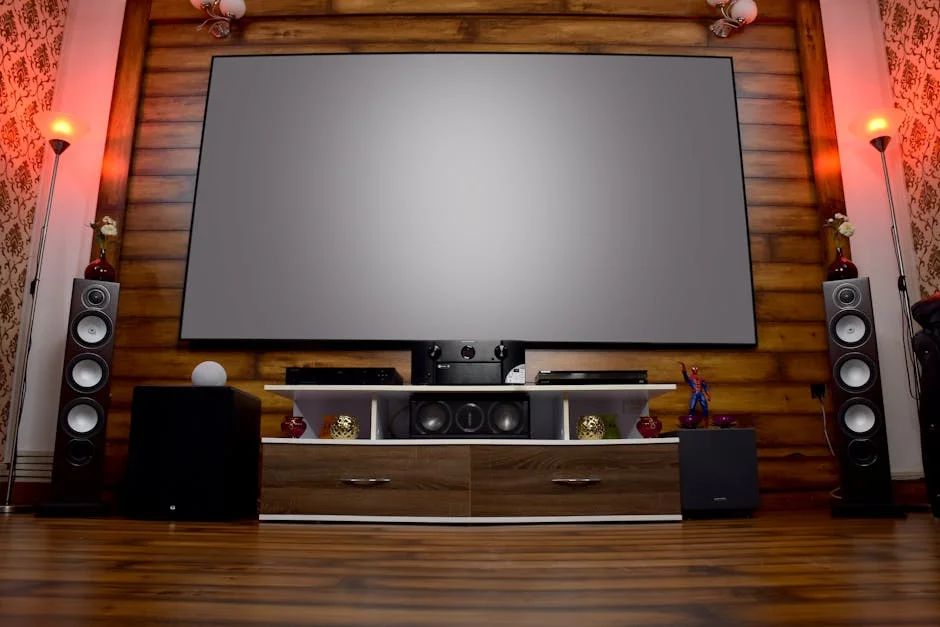
This is where most buyers underestimate the impact of their own space. Ambient light is the enemy of perceived contrast. A projector with genuinely excellent native contrast in a light-controlled room will be crushed in a room with bright walls, open windows, or strong overhead lighting. The inverse is also true: adequate contrast in a properly darkened room with neutral-to-dark wall treatment looks dramatically better than the spec sheet would suggest. Acoustic panels, dark paint, and controlled lighting are not optional upgrades for a dedicated theater. They are part of the display system.
Screen choice compounds this. An ALR (ambient light rejecting) screen like the Silver Ticket STR-169120 can meaningfully recover perceived contrast in rooms that can’t achieve full light control, but it isn’t a substitute for a room that’s properly set up. Bringing this up here is intentional: the screen matters as much as the projector. Most buyers spend heavily on the projector and treat the screen as an afterthought. The image lives on the screen, not inside the box. Get that backwards and you’ve spent money in the wrong direction.
Why Projector Contrast Ratio Matters
Contrast ratio is not the most important spec for every use case, but it matters more than brightness in the right conditions, and understanding when to prioritize it changes what you should be shopping for.
Dedicated Dark Room Viewing
If your space is a dedicated theater room with controlled lighting, contrast ratio becomes a primary image quality driver. Brightness can be dialed down to match screen gain and throw distance. Contrast cannot be added after the fact. Deep blacks and shadow detail in films like Dune, Interstellar, or anything shot with heavy chiaroscuro lighting depend on the projector’s ability to hold near-black levels without lifting into gray. This is where a projector’s native contrast spec, and ideally measured data from a trusted source, should weigh heavily in your decision.
Multipurpose and Ambient Light Spaces
In a living room with some light control, a rec room, or an outdoor setup, high brightness matters more. Contrast ratios in ambient light conditions collapse regardless of what the unit is rated at. Here, lumens-per-dollar becomes more practical. The specs that matter shift toward throw flexibility, keystone correction, wireless connectivity, and ease of setup. Contrast is still relevant, but chasing a 50,000:1 dynamic spec in a room with daylight coming in is largely a marketing exercise.
HDR Content
High dynamic range content is where contrast ratio collides directly with brightness in a way that creates real tradeoffs for projectors. HDR is designed for displays with high peak brightness and deep black floors simultaneously. Most projectors do not have the peak brightness to fully activate HDR highlights. Some handle tone mapping reasonably well. Others simply clip highlights. Understanding how a specific unit processes HDR (and reading field reports from buyers who have specifically addressed this) matters more than spec sheet numbers when evaluating HDR performance.
Top Picks Reviewed Against Contrast Spec Claims
The three units below each represent a different use case and contrast profile. None of them are in the same tier as my personal reference point, the Epson 4010 (LCD, pixel-shifted 4K-enhanced, premium price band). That context matters because it shapes what “good” looks like for the price bands covered here.
ViewSonic PA503HD 4000 Lumens High Brightness DLP Projector
The ViewSonic PA503HD 4000 Lumens High Brightness DLP Projector is a lamp-based DLP unit built primarily around brightness and flexibility rather than maximum contrast performance. Key specs: 4,000 lumens rated output, 1080p native resolution, standard throw with 1.1x optical zoom, and no native HDR support worth noting (the panel is not capable of meaningful HDR tone mapping at this brightness and contrast tier).
ViewSonic publishes a 22,000:1 contrast figure for this unit. That is a dynamic contrast number. Field reports from verified buyers on Amazon and AVS Forum threads indicate the native contrast is considerably lower, in line with what you’d expect from a mid-tier single-chip DLP. For a dark room cinephile, that’s a limitation. For a bright conference room, a classroom, or a backyard setup where ambient light is the dominant variable, 4,000 lumens of DLP punch is genuinely useful and the contrast limitation is largely irrelevant in context.
The lamp light source is the other significant consideration here. Lamp-based projectors typically spec 3,000 to 5,000 hours of lamp life in standard mode, with replacement costs that add to long-term ownership expense. Laser light sources in current mid-range units run 20,000 hours or more with no replacement cycle. For a unit used occasionally in a multipurpose room, lamp life is manageable. For a primary home theater running several nights a week, the math shifts.
Projector Central has measured data on comparable DLP units in this brightness class that would help calibrate expectations against the published spec.
Check current price on Amazon.
BenQ TH575 1080p Indoor Gaming Projector
The BenQ TH575 1080p Indoor Gaming Projector sits in mid-range pricing with a clear primary audience: gaming and mixed-use rooms where input lag matters as much as image quality. Core specs: 3,800 lumens, 1080p native, standard throw with 1.1x zoom, 16.7ms low latency in Game Mode, auto vertical keystone, and lamp-based light source. HDR support is listed as compatible but the tone mapping at this brightness tier is limited, as is typical for lamp projectors in this class.
BenQ rates contrast at 15,000:1, again a dynamic figure. For a gaming context, contrast matters most in dark atmospheric titles where shadow detail and black levels directly affect gameplay readability as well as visual immersion. Verified buyer reports across Amazon and AVS Forum generally note the image as punchy and satisfying in a moderately light-controlled room, which aligns with what single-chip DLP at this brightness level typically delivers.
The 16.7ms input lag in Game Mode is the genuine differentiator here relative to many projectors in this price band. That number is competitive. It won’t match a gaming monitor, but for console gaming on a large image, it’s workable for most content outside of high-level competitive play. BenQ’s three-year warranty adds meaningful peace of mind over the typical one-year coverage at this tier.
Lamp longevity carries the same caveat as the ViewSonic above. If this unit will be used heavily, factor lamp replacement into the ownership calculation.
Check current price on Amazon.
Outdoor-Projector-4K with WiFi and Bluetooth (ONOAYO ONO5Pro 2.0)
The Outdoor-Projector-4K with WiFi and Bluetooth is a smart projector designed for indoor/outdoor flexibility. Stated specs: 3,500 lumen brightness, onboard Dolby Audio speaker system (60W), AI auto focus, licensed smart TV app support, and wireless connectivity. The “4K” in the product name requires context: field reports and spec review suggest this is an upscaling unit rather than a native 4K panel, which is common at this price band and not inherently a dealbreaker for outdoor use.
Contrast ratio claims at this tier in the portable/smart projector category are the least reliable numbers in the projector space. Manufacturers of all-in-one smart projectors are not held to the same scrutiny as dedicated display brands with third-party lab reviews. Verified buyer feedback notes good outdoor performance at dusk and in partial ambient light, which is a reasonable real-world test. The onboard AI auto focus is a practical feature for a unit being set up and repositioned on a patio or in different rooms.
Compared to the Epson 4010 reference point, this is a different product category entirely. This is not a dedicated cinephile tool. It is a convenient all-in-one for movie nights on the lawn, guest rooms, travel, and casual viewing. Expecting flagship contrast performance from a unit in this class and form factor is a mismatch of expectations. For its intended use, the convenience features (built-in apps, auto focus, wireless audio) matter more than the contrast spec.
Check current price on Amazon.
Buying Guide: Choosing Based on Contrast Needs
This section covers what to actually look for before buying, organized by the decisions that separate appropriate projector choices from mismatched ones. If you’re still building your framework for evaluating projectors broadly, start here before getting into spec details.
Identify Your Room Conditions First
The single most important input into your projector selection is the light environment of the room where the unit will live. A dedicated dark room with blackout curtains, dark wall paint, and no ambient light sources rewards a projector with strong native contrast and lower lumen output. A living room with windows, a light ceiling, and reflective surfaces rewards brightness, and contrast becomes secondary.
Be honest about your room before you start reading spec sheets. Projector buyers routinely over-optimize for contrast specs in rooms where ambient light will undermine those gains entirely. Measuring your room’s ambient light level (even informally, by seeing how dark you can make it) shapes every downstream decision.
Native vs. Dynamic: Know Which Number to Trust
When evaluating any projector, look for independent measured data, not just the manufacturer’s published spec. Projector Central, Projector Reviews, and dedicated AVS Forum threads on specific models are the right sources. If a manufacturer publishes only a dynamic contrast number and no independent review exists with measured native contrast data, treat the spec as unverified.
For a dark room theater, a measured native contrast of 1,000:1 or higher is a reasonable floor. For a multipurpose or bright-room setup, native contrast below that threshold is often acceptable because the room light will be the binding constraint anyway.
Light Source Type and Longevity
Lamp projectors carry lower upfront cost in many cases, but lamp replacement is a real expense and a real inconvenience. Laser projectors (and LED-laser hybrids) spec 20,000 hours or more of rated life with no consumable replacement cycle. For a primary home theater used frequently, the math strongly favors laser. For occasional use in a guest room or outdoor setup, lamp is a reasonable tradeoff.
This distinction also affects consistency. Lamp output degrades over the bulb’s life, which means contrast and brightness both shift as the lamp ages. Laser sources hold output far more consistently across their lifespan.
Screen Selection Is Not Optional
Strong opinion, stated plainly: the screen is part of the contrast system, not an accessory to the projector. A high-gain screen increases perceived brightness, which can help contrast perception in a bright room. An ALR screen rejects off-axis light, preserving both brightness and contrast when full room control isn’t possible. A basic white gain screen in a bright room will undermine even excellent native contrast.
Pairing decisions matter. If you’re budgeting the build, putting weight on the screen surface is not a mistake. A mid-range projector on a properly chosen screen frequently outperforms a premium projector on a cheap white surface. Plan both purchases together.
Matching Contrast Expectations to Content Type
Films with heavy shadow detail and wide dynamic range (most modern cinema releases, HDR streaming content, UHD Blu-ray) place the highest demand on contrast. Gaming in dark atmospheric titles follows closely. Sports, daytime content, and bright animated films are much less contrast-sensitive.
If your primary content is sports and animated family movies, a high-brightness unit with moderate contrast and a bright-room setup is a better match than a lower-brightness unit optimized for deep blacks. Match the projector’s contrast profile to what you actually watch most, not to the most impressive content you occasionally show guests.
Frequently Asked Questions
Does a higher contrast ratio number always mean better picture quality?
Not automatically. The number type matters as much as the number itself. A projector with a 50,000:1 dynamic contrast spec may deliver a weaker real-world image than one rated at 15,000:1 native contrast, depending on how the dynamic figure is measured. Room conditions, screen choice, and how the projector processes HDR content all affect perceived image quality.
What contrast ratio is good enough for a home theater?
For a properly darkened dedicated room, measured native contrast of 1,000:1 or higher is a reasonable minimum for most buyers. Mid-range projectors in this range will handle most film content well in controlled conditions. Projectors above 2,000:1 native contrast deliver noticeably better shadow detail and black floor performance. For casual or ambient-light viewing, the room is the binding constraint and raw contrast spec matters less than brightness.
Is 4K resolution more important than contrast ratio?
They address different things. Resolution determines fine detail and sharpness. Contrast determines depth, perceived image dimension, and how convincing dark scenes look. In a dark room, strong contrast often reads as a more cinematic image than extra resolution at equivalent contrast.
Do DLP and LCD projectors produce different contrast performance?
Generally yes, though both technologies have improved. Single-chip DLP tends to produce stronger native contrast because the DMD mirrors switch fully off, allowing deeper blacks within a frame. LCD panels can allow some light leakage in dark areas, historically a black-level weakness, though modern designs have narrowed the gap. Neither technology is uniformly superior across all models.
How does room lighting affect what contrast ratio I need?
A fully darkened room magnifies the perceptual difference between projectors with different native contrast specs. Ambient light compresses perceived contrast across all projectors by lifting the black floor through screen reflection. In a room that cannot be fully darkened, the practical gap between a 2,000:1 and a 5,000:1 native contrast projector shrinks considerably. High brightness and an ALR screen often deliver more real-world image improvement in ambient light rooms than chasing a higher contrast specification.
<script type="application/ld+json">
{
 "@context": "https://schema.org",
 "@type": "FAQPage",
 "mainEntity": [
 {
 "@type": "Question",
 "name": "Does a higher contrast ratio number always mean better picture quality?",
 "acceptedAnswer": {
 "@type": "Answer",
 "text": "Not automatically. The number type matters as much as the number itself. A projector with a 50,000:1 dynamic contrast spec may deliver a weaker real-world image than one rated at 15,000:1 native contrast, depending on how the dynamic figure is measured. Room conditions, screen choice, and how the projector processes HDR content all affect perceived image quality. Always look for independent measured data rather than relying on manufacturer-published contrast claims."
 }
 },
 {
 "@type": "Question",
 "name": "What contrast ratio is good enough for a home theater?",
 "acceptedAnswer": {
 "@type": "Answer",
 "text": "For a properly darkened dedicated room, measured native contrast of 1,000:1 or higher is a reasonable minimum for most buyers. Mid-range projectors in this range will handle most film content well in controlled conditions. Projectors above 2,000:1 native contrast deliver noticeably better shadow detail and black floor performance. For casual or ambient-light viewing, the room is the binding constraint and raw contrast spec matters less than brightness."
 }
 },
 {
 "@type": "Question",
 "name": "Is 4K resolution more important than contrast ratio?",
 "acceptedAnswer": {
 "@type": "Answer",
 "text": "They address different things. Resolution determines fine detail and sharpness. Contrast determines depth, perceived image dimension, and how convincing dark scenes look. In a dark room, strong contrast often reads as a more cinematic image than extra resolution at equivalent contrast. In practice, both matter, but shadow detail failures at low contrast ratios are typically more visually distracting than the gap between 1080p and 4K at normal seating distances."
 }
 },
 {
 "@type": "Question",
 "name": "Do DLP and LCD projectors produce different contrast performance?",
 "acceptedAnswer": {
 "@type": "Answer",
 "text": "Generally yes, though both technologies have improved. Single-chip DLP tends to produce stronger native contrast because the DMD mirrors switch fully off, allowing deeper blacks within a frame. LCD panels can allow some light leakage in dark areas, historically a black-level weakness, though modern designs have narrowed the gap. Neither technology is uniformly superior across all models. Specific unit measurements from independent reviewers matter more than the technology category alone."
 }
 },
 {
 "@type": "Question",
 "name": "How does room lighting affect what contrast ratio I need?",
 "acceptedAnswer": {
 "@type": "Answer",
 "text": "A fully darkened room magnifies the perceptual difference between projectors with different native contrast specs. Ambient light compresses perceived contrast across all projectors by lifting the black floor through screen reflection. In a room that cannot be fully darkened, the practical gap between a 2,000:1 and a 5,000:1 native contrast projector shrinks considerably. High brightness and an ALR screen often deliver more real-world image improvement in ambient light rooms than chasing a higher contrast specification."
 }
 }
 ]
}
</script>Where to Buy
ViewSonic PA503HD 4000 Lumens High Brightness DLP Projector with 1.1x Optical Zoom, USB, and HDMI inputs for Home and OfficeSee ViewSonic PA503HD 4000 Lumens High Br… on Amazon